Effective Programming: Introduction to Computer Vision with Deep Learning
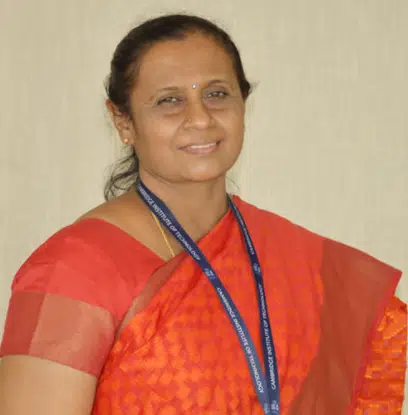
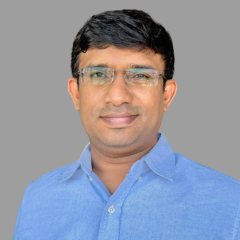
Dr. Bharatesh Chakravarthi
Assistant Teaching Professor, School of Computing and Augmented Intelligence, Ira A. Fulton Schools of Engineering, Arizona State University.
- Build an intuitive understanding of how computers interpret and learn from images and videos.
- Learn the fundamental building blocks of deep learning for vision tasks.
- Gain practical experience using Python and TensorFlow on Google Colab for image classification, detection, and segmentation.
- Explore real-world and emerging applications of computer vision, including neuromorphic sensing.
| Day No. | Topics Covered |
|---|---|
| Day 1 |
• Introduction to fundamental concepts of Deep Learning • Relationship between Artificial Intelligence, Machine Learning, and Deep Learning |
| Day 2 |
• Introduction to data and types of Machine Learning • Artificial Neural Networks and perceptron concepts • Solving numerical problems related to perceptrons |
| Day 3 |
• Binary classification using Perceptrons • Introduction to Teachable Machines • Practical exposure to MNIST handwritten digit dataset using deep learning frameworks |
| Day 4 |
• Introduction to Deep Neural Networks (DNN) • Activation functions and forward & backward propagation • Necessity of Convolutional Neural Networks (CNN) for image data |
| Day 5 |
• Practical implementation of computer vision concepts • Application of deep learning techniques for image-based tasks |
| Day 6 |
• Overview of advanced computer vision concepts • Core deep learning architectures and real-world perception problems • Emerging sensor technologies and hands-on implementation tasks |
| Day 7 |
• Practical applications of CNNs in image recognition • Sensor fusion techniques and their importance in modern AI systems |
| Day 8 |
• Complete pipeline from sensing and localization to simulation • Datasets and deep learning architectures for autonomous systems • Integration of GPS and IMU systems • Use of simulators like CARLA to accelerate development |
| Day 9 |
• Deep learning architectures from AlexNet to GoogLeNet • Overview of Waymo Open Dataset • Model deployment using NVIDIA Jetson Nano • Assessments and course closure |
Subject Matter Expert
Dr. Bharatesh Chakravarthi is a Career Track Assistant Teaching Professor in the School of Computing and Augmented Intelligence (SCAI) at Arizona State University, USA, where he joined in Fall 2024. Prior to this appointment, he served as a Postdoctoral Research Associate at ASU from 2022 to 2024. He earned his Ph.D. in Computer Graphics and Virtual Reality from Chung-Ang University in Seoul, South Korea, and began his early academic career at engineering institutes under Visvesvaraya Technological University. Dr. Chakravarthi’s research focuses on multimodal vision and artificial intelligence, with particular emphasis on intelligent transportation systems and autonomous systems.
With more than 13 years of national and international academic and research experience, he has published in premier conferences and journals, been recognized for his open-source contributions, and delivered invited talks across both industry and academia. He also serves on program committees and has held several academic service and leadership roles throughout his career.